Cryptocurrency

Faucets

General

Latest Updates

Showing posts with label bitcoin. Show all posts

Gold Vs. Bitcoin: Who You Got?

05:16
Gold Vs. Bitcoin: Who You Got?

Gold Vs. Bitcoin: Who You Got?

Investment Thesis

Over the past few years, an increasingly wide range of cryptocurrencies have come into existence. Bitcoin is a very recent innovation of cryptocurrencies.
In the comparative analysis that will follow, we will unfold each of their respective advantages and disadvantages by comparing and contrasting bitcoins against gold.
Each of these two has unique investment characteristics in consideration of five parameters namely, durability, intrinsic value, price volatility, portability and divisibility.
This article will also let us judge, which of the two is a better investment choice. Bitcoin being a speculative financial asset faces the challenge as a store of value due to vulnerable monetary policy decisions. Gold never fails being a store of value and a rare commodity.

Gold and Bitcoins

1. Durability
Gold seems to win out against bitcoins in durability. Both of them require some level of expertise to keep them for a long time. However, correct long-term storage and security is extremely challenging for several reasons.
Bitcoins are vulnerable to hacking. MyBitcoin.com (an online wallet) had approximately 51% of its bitcoins stolen at an estimated value of $49 million. To date, the biggest bitcoin hack was done in the online currency exchange Mt. Gox. Rampant thefts reported from 2011 until its closure in 2014 which took $500 million worth of bitcoins.
There are significant regulatory risks surrounding bitcoins. Many regulators have expressed concerns over bitcoins and the related field of Initial Coin Offerings (ICO), given the short history of the technology and its inherent abilities to audit "Know Your Customer" (KYC) and Anti Money Laundering (AML) legislation.
Bitcoins are also subject to network or infrastructure risk. Bitcoins work on blockchain technology which is "splitting" the internet into two infrastructure. There is still an inherent risk to bitcoins if the internet were ever to "split". It would be possible for bitcoin holders to "double spend" the same bitcoin.
2. Intrinsic Value
Gold is not subject to competition from alternatives, while bitcoins are. Rarity is electronically built into the codes of cryptocurrencies. This would again appear to make bitcoins the better choice over gold, as limited supply is a mathematical certainty. Gold has a limited supply in the earth's crust. However, a key property of all precious metals is that they are "elements".
Elements are not invented, they are discovered, and we have already discovered all the elements neighboring the precious metals. It is impossible that an "alternative" precious metal will ever emerge in the earth's crust.
Hence, there is no control over the supply of bitcoins at a macroeconomic level. Bitcoins can multiply into "alternatives'', and it has a high potential of substitutability to its original form. It has no intrinsic value due to rarity unlike gold.
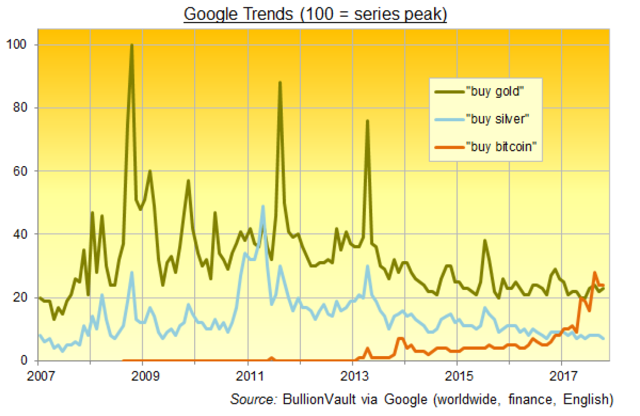
The data below were gathered from Google Trends. It shows the number of internet searches for the phrase "buy gold", "buy silver" and "buy bitcoins". Search for "buy bitcoins" seems to be fast catching up lately with the other two.
https://static.seekingalpha.com/uploads/2017/11/10/48821419-15103053174973893.png
Source: BullionVault
3. Price Volatility
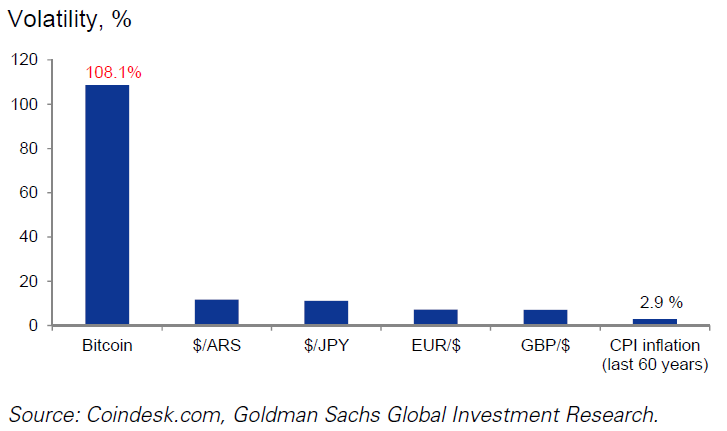
Gold has a long history of maintaining its purchasing power. Bitcoin fails to maintain price stability historically. The extreme volatile exchange rate of bitcoin necessitates a bigger risk premium in order to hedge forex risk.
Simply put, a seller who accepts bitcoins for transactions, will require him to change it into US dollars the following day. After which, he waits further two days for clearance. Taken all together, a risk premium of approximately 2.3% will be needed to hedge forex risk.
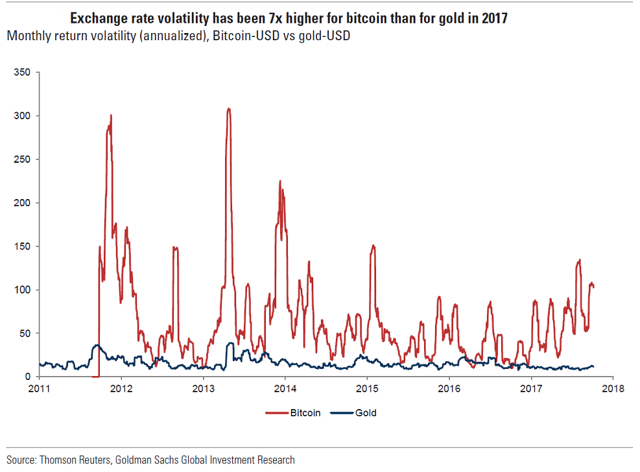
The table below shows that Bitcoin/USD volatility averaged almost 7 times that of gold in 2017:
https://static.seekingalpha.com/uploads/2017/11/10/48821419-15103053199913723.png
Source: Thomson Reuters, Goldman Sachs Global Investment Research
4. Portability
Transferring gold can be expensive given its weight, high import taxes (such as in India), the need for a high level of security. In contrast, since there is no need to make a physical transfer with bitcoin - just a transfer of ownership in a distributed database called blockchain (which is already held digitally by computers all over the world). It is much faster and less expensive to move bitcoins.
5. Divisibility
Gold physical transfers usually only occur for larger values, with transactions typically occurring in 400 tonnes per ounce (or 11.3kg) or 1kg bars. The smallest Bitcoin unit is 1 satoshi.
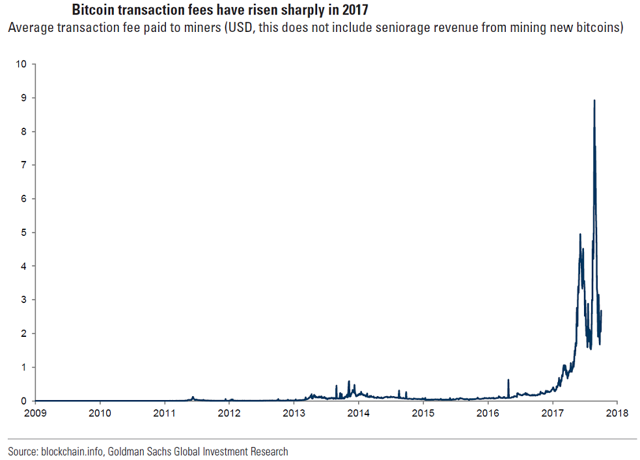
The currency is close to infinite divisibility with 100 million satoshis for each bitcoin. This makes bitcoins seem a much better candidate from the perspective of divisibility. However, much higher transaction fees were being charged for bitcoin users with average transaction fee growing to more than $2 since mid-2017, as compared with less than 1 cent charged in previous years.
The chart below exhibits the trend for average transaction fees paid to cryptocurrency miners:
https://static.seekingalpha.com/uploads/2017/11/10/48821419-15103053215885484.png

Our Takeaway

We prefer to endorse gold to investors, given a number of factors cited in this comparative analysis.
Gold has pure intrinsic value due to its rarity. There is a long history of unregulated currencies. Gold has been an unregulated currency at various times and in various places.
Investors always get to an unregulated currency. There is a government that regulates but it does not control the money supply very well. In some occasions, a number of investors do not trust the official currency. Bitcoin just seems to be another version of this. It is a lot like gold, in fact. Obviously, the difference is bitcoin is digital rather than a heavy, unwieldy object.
That means that bitcoins could serve the same purposes as gold in terms of a currency. It does not have any mass and can be sent easily from place to place.
In terms of price trends, it is also less volatile than bitcoins. Gold price never dropped 40%, which bitcoin has - on a couple of occasions last year. Unlike gold, bitcoin also has no fundamental value from alternative uses that could anchor its price.
This does not mean that the value of bitcoin might not rise over time. If demand grows against a finite supply, it will happen. But without an issuer who could guide price changes, or an alternative valuable use, the notion that its value will be stable is harder to envisage. The lack of these two foundations may end up to bitcoin's price more susceptible to self-fulfilling price dynamics.
Disclosure: I/we have no positions in any stocks mentioned, and no plans to initiate any positions within the next 72 hours.
I wrote this article myself, and it expresses my own opinions. I am not receiving compensation for it (other than from Seeking Alpha). I have no business relationship with any company whose stock is mentioned in this article.
Additional disclosure: This article was written by Hans Centena, our business journalist. Gold News is not a registered investment advisor or broker/dealer. Readers are advised that the material contained herein should be used solely for informational purposes. Investing involves risk, including the loss of principal. Readers are solely responsible for their own investment decisions.

ALSO READ:  Bitcoin Continues to Beat Gold


Bitcoin Continues to Beat Gold

04:46
Bitcoin Continues to Beat Gold

Bitcoin Continues to Beat Gold


Cryptocurrency has been an extremely fruitful market for many investors in the space. One of the best of those coins continues to be the one with the highest market capitalization known as bitcoin.

Bitcoin has had an incredible rally this year, and when compared to gold, it continues to beat it out.

This year represents the second year in a row that bitcoin has beat out gold on the Wall Street market, and it doesn’t look like it is slowing down anytime soon. Many continue to ask the question of whether or not bitcoin is a solid investment, and that remains quite a tricky question to answer.


Since bitcoin has been around for such a small amount of time relatively, so many investors do not know how to fully read the space, but the coin has proven to be quite similar in terms of chart patterns, to most other assets.

Professor Geoffrey Smith at the Carey School of Business at Arizona State University stated that “bitcoin has many advantages over government currencies, not the least of which is that its supply is fixed. Thus, its purchasing power cannot be diminished by ‘currency printing’ by governments. See Venezuela and their inflation, for example. Anonymity is also an advantage. The blockchain technology also provides perfect record keeping which eliminates mistakes and the opportunity for fraud and theft.”


The professor further stated that “Bitcoin is also an international currency, which can be used to facilitate international trade. It may also be very useful in low-trust countries with high levels of corruption where the banking system and legal system protections are not very strong. It remains to be seen, however, if it is useful as a currency due to the high volatility. Yet the number of Bitcoin transactions seems to be increasing every day.”

ALSO READ:  Gold Vs. Bitcoin: Who You Got?


Source: https://typeboard.com

What is Bitcoin? Here's everything you need to know Blockchains, bubbles and the future of money.

What is Bitcoin? Here's everything you need to know Blockchains, bubbles and the future of money.

What is Bitcoin? Here's everything you need to know

Blockchains, bubbles and the future of money.

You heard about this Bitcoin thing?

We're guessing: yes, you have. The first and most famous digital cryptocurrency has been racking up headlines this year due to a breathtaking rise in value -- cracking the $1,000 threshold for the first time on January 1 before ascending to nearly $19,000 this month.

 
Bitcoin involves technology, currency, math, economics and social dynamics. It's multifaceted, highly technical and still very much evolving. This explainer is meant to clarify some of the fundamental concepts and provide answers to some basic Bitcoin questions.

But first: A quick backstory

Bitcoin was invented in 2009 by a person (or group) who called himself Satoshi Nakamoto. His stated goal was to create "a new electronic cash system" that was "completely decentralized with no server or central authority." After cultivating the concept and technology, in 2011, Nakamoto turned over the source code and domains to others in the Bitcoin community, and subsequently vanished.

What is Bitcoin?

Simply put, Bitcoin is a digital currency. No bills to print or coins to mint. It's decentralized -- there's no government, institution (like a bank) or other authority that controls it. Owners are anonymous; instead of using names, tax IDs, or social security numbers, Bitcoin connects buyers and sellers through encryption keys. And it isn't issued from the top down like traditional currency; rather, Bitcoin is "mined" by powerful computers connected to the internet.

How does one 'mine' Bitcoin?

A person (or group, or company) mines Bitcoin by doing a combination of advanced math and record-keeping. Here's how it works. When someone sends a Bitcoin to someone else, the network records that transaction, and all of the others made over a certain period of time, in a "block." Computers running special software -- the "miners" -- inscribe these transactions in a gigantic digital ledger. These blocks are known, collectively, as the "blockchain" -- an eternal, openly accessible record of all the transactions that have ever been made.

Using specialized software and increasingly powerful (and energy-intensive) hardware, miners convert these blocks into sequences of code, known as a "hash." This is somewhat more dramatic than it sounds; producing a hash requires serious computational power, and thousands of miners compete simultaneously to do it. It's like thousands of chefs feverishly racing to prepare a new, extremely complicated dish -- and only the first one to serve up a perfect version of it ends up getting paid.

When a new hash is generated, it's placed at the end of the blockchain, which is then publicly updated and propagated. For his or her trouble, the miner currently gets 12.5 Bitcoins -- which, in December 2017, is worth more than $225,000. Note that the amount of awarded Bitcoins decreases over time.

What determines the value of a Bitcoin?

Ultimately, the value of a Bitcoin is determined by what people will pay for it. In this way, there's a similarity to how stocks are priced.

The protocol established by Satoshi Nakamoto dictates that only 21 million bitcoins can ever be mined -- about 12 million have been mined so far -- so there is a limited supply, like with gold and other precious metals, but no real intrinsic value. (There are numerous mathematical and economic theories about why Nakamoto chose the number 21 million.) This makes Bitcoin different from stocks, which usually have some relationship to a company's actual or potential earnings.


Without a government or central authority at the helm, controlling supply, "value" is totally open to interpretation. This process of "price discovery," the primary driver of volatility in Bitcoin's price, also invites speculation (don't mortgage your house to buy Bitcoin) and manipulation (hence the recent talk of tulips and bubbles).


Bitcoin has made Satoshi Nakamoto a billionaire many times over, at least on paper. It's minted plenty of millionaires among the technological pioneers, investors and early Bitcoin miners. The Winklevoss twins, who parlayed a $65 million Facebook payout into a venture capital fund that made early investments in Bitcoin, are now billionaires according to Fortune.

How do I buy Bitcoin?

If you're willing to assume the risk associated with owning Bitcoin, there is an increasing number of digital currency exchanges like Coinmama, CEX, Kraken and Coinbase -- the largest and most established of them -- where you can buy, sell and store Bitcoins.

Getting started is about as complicated as setting up a Paypal account. With Coinbase, for example, you can use your bank (or Paypal account) to make a deposit into a virtual wallet, of which there are many to choose from. Once your account is funded, which usually takes a few days, you can then exchange traditional currency for Bitcoin.

What can I do with Bitcoin?

You can use Bitcoin to buy things from more than 100,000 merchants, though still few major ones. You can sell it. Or you can just hang on to it. Note that there are no inherent transaction fees with Bitcoin, although exchanges like Coinbase typically charge a fee when you buy or sell.

Is all of this legal?


Short, qualified answer: yes, for now, as long as -- like any currency -- you don't do illegal things with it. For instance, Bitcoin was the sole currency accepted on Silk Road, the dark Web marketplace for drugs and other illicit goods and services that was shuttered by the FBI in 2013.

Since then, Bitcoin has largely evaded regulation and law enforcement in the US, although it's under increased scrutiny as it attracts more mainstream attention. Though it's legal to buy and sell Bitcoin, miners and exchanges occupy a gray area that could be vulnerable to future regulation and/or law enforcement action.

What are the risks?

Legal and regulatory hazards aside, as both an investment and currency, Bitcoin is very risky. When you wake up in the morning, you know pretty precisely how much a dollar can buy. The financial value of a Bitcoin, however, is highly volatile and may swing widely from day to day and even hour to hour.

Bitcoin transactions cannot be traced back individuals -- they are secured but also obscured through the use of public and private encryption keys. This anonymity can be appealing, especially with companies and marketers increasingly tracking our every purchase, but it also comes with drawbacks. You can never be certain who is selling you Bitcoin or buying them from you.  Opportunities for money laundering abound; last year, authorities in the Netherlands arrested 10 men for just this.
Theft is also a risk. The Bitcoin subreddit is rife with individuals' stories and even established exchanges are targets. Mt. Gox, based in Japan, "lost" 750,000 of its customers' Bitcoins in 2014 and hackers took $60 million from NiceHash earlier this month. There are few avenues for pursuing refunds, challenging a transaction or recovering such losses. Once a transaction hits the blockchain, it's final.

OK, so what about --- wait, there are more risks?


Because Bitcoin is so new and decentralized, there is plenty of murkiness and many unknowns. Even the technical rules for mining are still evolving and up for debate.
The IRS views Bitcoins as property, not currency. There are tax implications and a federal judge recently ruled that Coinbase must surrender records to the IRS on transactions of $20,000 or more.

Then there's the fundamental question of whether you should trust a particular exchange. Even Coinbase, the most established of them all has struggled to keep up with demand, plagued by site outages, scaling issues and customer service complaints. Even if it's venture-backed, every Bitcoin player today is by definition a startup and comes with all of the associated risks.

Now I sort of understand Bitcoin. WTF is Bitcoin Cash?

In August 2017, different sects within the Bitcoin mining community had a disagreement about the rules governing the mining process -- specifically, what constitutes the appropriate size (in megabytes) of a block. Unable to form a consensus, there was a fork in the blockchain, with the Bitcoin originalists going one way and the group favoring larger blocks going another.
Though they share a common digital ancestry, each now has its own individual blockchain with slightly different protocols. (For what it's worth, Bitcoin miners are sticking with 1MB blocks, Bitcoin Cash uses 8MB blocks.) Forking is almost assured to happen again in the future.

Are there other cryptocurrencies?

Yes. More than a thousand, with more sprouting up every day. Aside from Bitcoin, which is the real progenitor of them all, other well-known alternative currencies include Ethereum, Ripple and Litecoin. We'll take a look at the pros and cons of each, and how they stack up, in a future explainer.


Source: https://www.cnet.com/how-to/what-is-bitcoin/

What is Ripple? The cryptocurrency growing faster than bitcoin explained

04:04
What is Ripple? The cryptocurrency growing faster than bitcoin explained

What is Ripple? The cryptocurrency growing faster than bitcoin explained


Ripple has been on a tear over the past few weeks: XRP, the token that powers the blockchain startup’s network, RippleNet, first hit $1 about two weeks ago, and today it climbed to as high as $3.84.


While bitcoin, the cryptocurrency king, soared more than 1,200 per cent last year, Ripple rose a whopping 35,000 per cent in the same period.
Ripple is now the second-largest cryptocurrency by market capitalisation behind bitcoin, having reached more than $140bn today. Compared to bitcoin’s $250bn value, it is still a long way off, but with its rapid rise in value meaning Ripple is attracting more attention than ever, here’s everything you need to know.

What is Ripple?

Ripple is a San Francisco-based blockchain startup led by chief executive Brad Garlinghouse that dates back to 2012. It works with a number of institutions including UBS, Santander and American Express to apply blockchain technology to payments, making them faster and cheaper.

How does it compare to bitcoin?

While Ripple has its own digital token, any currency - including bitcoin - can be traded on RippleNet. Dennis de Jong, managing director at UFX, said: “While the governance of bitcoin and other cryptocurrencies remains unstable, Ripple’s seems far more reliable, with validators run by MIT and Microsoft.”

How is it used by banks?

Iqbal Gandham, UK managing director at eToro, said Ripple allows banks, payment providers and businesses to improve cross-border payments, expand into new markets, increase payment volume, lower foreign exchange costs and provide faster settlement times for customers.
With Ripple, cross-border payments can be completed within seconds while bitcoin can take an hour or longer, and the Society for Worldwide Interbank Financial Telecommunication (Swift) network takes about three days. De Jong said the quick settlement times and extremely low transaction fees could increase remittance profitability for some smaller banks to up to 60 per cent. “The fact that the likes of American Express and Santander have signed up shows it certainly is an attractive proposition that should grow and grow,” he said.

Why is Ripple controversial in the crypto community?

Gandham said there were a number of reasons why not every cryptocurrency fan has jumped on the Ripple bandwagon. The decentralised nature of bitcoin and other cryptocurrencies is seen as one of the main selling points, but Ripple is owned by Ripple Labs and centralised there, which Gandham said was “in direct opposition to one of the basic tenents of cryptocurrencies”. He added: “Secondly, Ripple could in theory increase the supply of XRP and the crypto community would not be able to stop this. Thirdly, the XRP token is not vital for the Ripple network, which could survive without XRP.”

Where will Ripple’s price go from here?

Gandham said the recent rally in XRP’s price could be attributed to the expansion of Ripple’s global network, which now consists of more than 100 customers and over 75 commercial deployments. “From American Express to Santander and Standard Chartered, Ripple’s adoption by financial institutions is on the rise – which has strengthened the demand for XRP,” he said.
De Jong added that every time a new bank takes on Ripple, the price of XRP will increase sharply. “2016 and 2017 saw banks trialling the product, with this year likely to see some major implementations – which means we could see some very quick short-term growth. Whether this is able to last longer-term, however, does still remain to be seen.” He said: “Bitcoin’s peaks and valleys are already well-known, but Ripple’s relentless growth and record highs don’t alter the fact that it’s only just begun its crypto-coaster ride.”

How do you buy XRP?

Individuals can purchase XRP from a number of exchanges, including Bitstamp, Kraken, Gatehub and Coinone.

Also read: Ripple Becomes Second Biggest Cryptocurrency After Bitcoin As Price Jumps 40% in one day.
Source: 

Ripple Becomes Second Biggest Cryptocurrency After Bitcoin As Price Jumps 40% In One Day

09:17
Ripple Becomes Second Biggest Cryptocurrency After Bitcoin As ...

Ripple Becomes Second Biggest Cryptocurrency After Bitcoin As Price Jumps 40% In One Day

Story Highlights

  • Ripple price races towards $4 per coin
  • Ripple's market cap is over $140 billion on Thursday
  • Ripple's price has been rising consistently since December 30
Ripple's (XRP) price hit past $3.80, taking the market capitalization of digital currency beyond $140 billion, only second in the cryptocurrency market after bitcoin with a market cap of close to $250 billion. The ripple's price has been rising consistently since December 30 last year when it closed at $2.16 per coin. The next day, the price rose to $2.30. On the first day of 2018, the price jumped to $2.39. On January 2, the price was $2.48. On Wednesday (January 3), the ripple price hit $3 for the first time before closing at $3.11. On Thursday, the price is racing towards $4 per coin.
In 2017, the ripple price jumped by 3,500 times. On Thursday, ripple is priced around $3.80, litecoin can be bought for $231, while bitcoin is available for a whopping $14,468. However, in the beginning of 2017, the prices of bitcoin, litecoin and ripple were $1,000, $4.3 and $0.006311, respectively. This means, ripple gave 36,000% returns and litecoin gave 5,200% return in comparison to the 1,400% return earned by bitcoin investors.
Launched in 2012, Ripple had a market cap of $140 billion, next to the Bitcoin's. It is used by companies such as UBS and Santander as payment technology. In November 2017, American Express Co also launched an instant blockchain-based payment system using Ripple.
At the same time, the price of bitcoin has been, by and large, consistent. While the BTC prices jumped to near $20,000 on December 17 in run up to its futures trading at CME Group, the prices later retreated to the fold of $14,000-$15,000. Ripple's price (in the last week of 2017) surged past $2.3 since there was a news that the South Korean and Japanese banks were testing the viability of cryptocurrency's usage in cross border payments.


Source: ndtv

Bitcoin Eyes $18,000 as Tide Turns in Bulls' Favor

06:09
Bitcoin Eyes $18,000 as Tide Turns in Bulls' Favor

Bitcoin is strongly bid today amid reports of institutional buying.
Prices across global exchanges, as per CoinDesk's Bitcoin Price Index, were last seen trading at $14,951 levels. The cryptocurrency caught a bid wave at $13,687.54 (price at 17:00 UTC yesterday) and jumped to a six-day high of $15,393.97 earlier today.
Notably, the news that Founders Fund (co-founded by high-profile investor Peter Thiel) has poured $15 million–$20 million into bitcoin (BTC) looks to have given a lift to prices of the number one cryptocurrency by market capitalization.
As detailed in our explainer, Founder Fund's entry into the bitcoin space is not surprising. Nevertheless, the news does underscore the rising level of interest among institutional investors and thus could have pushed up bitcoin prices.
As per data source CoinMarketCap, the world's largest cryptocurrency has appreciated by 10 percent in the last 24 hours.
Despite the retreat from the intraday high, the technical charts look constructive.

Bitcoin chart

The above chart (prices as per Coinbase) shows:
  • Bitcoin followed the historical pattern: a sell-off from the record high of $19,891 (Dec. 17) ended around the 61.8 percent Fibonacci retracement level on Dec. 22 (marked by a circle).
  • Bulls successfully defended the confluence of the upward sloping 50-day moving average and 50 percent Fibonacci retracement level ($12,701.55) over the weekend.
  • A high-volume "falling wedge" reversal (bullish breakout).
  • The relative strength index (RSI) has breached the descending trendline, favoring a further rise in BTC prices.
A falling wedge is characterized by lower lows and lower highs with a contracting range. An upside break (as witnessed yesterday) indicates a bullish trend reversal – i.e. the sell-off from $19,891.99 (Dec. 17 high) has ended and the bulls have regained control.
The pick up in volume yesterday indicates strong hands are at play.

View

The chart indicates that prices could revisit $18,000 in the short-run. However, the decline of the intraday high of $15,400 to $14,650 neutralizes the immediate outlook.
A move above $15,400 in the next few hours would add credence to the bullish technical factors listed above and shall open doors for $16,490 (Dec. 27 high). A violation there would expose resistance at $18,149.99 (Dec. 12 high).
On the downside, only a close (as per UTC) below $12,701.55 (50 percent Fibonacci retracement) would revive the bear market.

Source: coindesk

How to buy bitcoin: A beginner's guide to purchasing the cryptocurrency and not being scammed

10:11
How to buy bitcoin: A beginner's guide to purchasing the cryptocurrency and not being scammed

How to buy bitcoin: A beginner's guide to purchasing the cryptocurrency and not being scammed


The value of bitcoin has hit a new record high of more than $19,850, and mainstream interest in the cryptocurrency continues to climb.

The notoriously volatile currency is expected to carry on fluctuating unpredictably, which is why numerous financial experts are urging people not to et involved with bitcoin, believing that the boom can only end badly.

However, if you’re still curious and want to find out more, here’s how beginners can buy bitcoin.

The easiest way to get involved is by signing up to a bitcoin wallet service. You can also “mine” bitcoin using a supercomputer – an unrealistic option for most people – or set up and control your own wallet, but using a third-party service is far simpler.

Some of the most popular options are Coinbase, Blockchain.info and Xapo, which you can use on both desktop and mobile.

You can sign up to these as you would sign up to any website. Enter your name and email address and set a password to get started.

After that, it’s time to connect your bank account, debit card or credit card.

Use two-factor authentication to secure your account, but don’t use your phone number or SMS for this. According to security researchers, criminals only need to know your name and number in order to steal from your bitcoin wallet.

Instead, use Google Authenticator or a security key, such as the YubiKey.

Once you’ve done this, you can start investing in bitcoin. Whichever service you decide to use, you’ll be able to access a graph showing how bitcoin’s value has changed over time. It’s likely to look extremely jagged.

With the value of bitcoin so high at the time of writing, it may come as a relief to hear that it is perfectly possible – and not at all unusual – to purchase small fractions of bitcoin.

Once you’ve established how much traditional money you’re willing to invest, complete your exchange through the wallet service, following their instructions.

However, we can only reiterate how risky the move could be. Not only is bitcoin extremely volatile, but investors in it and other cryptocurrencies are frequently targeted by criminals.

Earlier this month, for instance, the value of bitcoin dropped by 5.4 per cent after $31m worth of cryptocurrency Tether was stolen. Coinbase users have been targeted successfully too.

The best thing you can do to protect yourself is to always proceed with extreme caution.
Scammers constantly use phishing attacks to try to trick people into visiting malicious websites that look official, but aren’t.

They commonly send out fake but legitimate-looking emails, which you need to be wary of. To stay safe, you simply shouldn’t engage with them.

Don’t follow any links in the messages or enter any private details they ask you for. Instead, you should always make sure you’re on the right website or app.

People are also being duped by malicious websites promising quick profits and trading tips. Again, use common sense to protect yourself, and don’t take any unnecessary risks.

Bitcoin transactions are irreversible, so if any of the currency leaves your account, you won’t be able to get a refund. It’s also easy to lose bitcoin, and once it’s gone it can be tough to get back.
Bookmark your wallet service’s website if necessary.

Some services, such as Coinbase, allow to you set price alerts that tell you when the value of bitcoin has dipped below or climbed above specific figures.

When you decide it’s time to sell up, you can complete the transaction through the wallet service.

ALSO READ: Bitcoin is the 'most crowded' investment in the world, according to widely followed investor survey


Source: independent.co.uk

Bitcoin is the 'most crowded' investment in the world, according to widely followed investor survey

10:10
Donat Sorokin | TASS | Getty Images
The Bitcoin cryptocurrency symbol on a stone sphere monument painted black by unidentified persons in Oktyabrskaya Square in Yekaterinberg, Russia.

Bitcoin is the 'most crowded' investment in the world, according to widely followed investor survey


Bitcoin tops the list of "most crowded trades" — a measure of sentiment on which popular investment could quickly reverse its gains— in Bank of America Merrill Lynch's December global fund manager survey.
  • The survey finds 32 percent of respondents named bitcoin as the most crowded trade, up from 26 percent in September when the digital currency first led the list.
  • Another crowded trade is betting on the stocks of U.S. and Chinese technology giants, 29 percent of respondents said.


  • More traditional money managers are worried about bitcoin than ever before.
    The soaring digital currency topped the list of "most crowded trades" — a measure of sentiment on which popular investment could quickly reverse its gains— in Bank of America Merrill Lynch's December global fund manager survey released Tuesday.

    The survey found that 32 percent of respondents named bitcoin as the most crowded trade in the financial world, up from 26 percent in September when the digital currency first led the list. At the time, bitcoin had surged about 375 percent for the year to $4,600.

    But clearly that was not the top, despite a rocky September for bitcoin in which the digital currency briefly plunged more than $2,000 as China cracked down on cryptocurrencies and J.P. Morgan Chase CEO Jamie Dimon called bitcoin a "fraud" that "won't end well."

    December's "most crowded trades"


    Bitcoin has roughly quadrupled since September to briefly trade above $19,000 in the last week. Fueling part of the rally was the launch of bitcoin futures on the CME, the world's largest futures exchange, and its competitor Cboe's Futures Exchange.

    The BofAML survey, conducted from Dec. 8 to 14, covered 172 global fund managers with a total $480 billion in assets under management. It's widely considered one of the best surveys of investors conducted on Wall Street.

    Another crowded trade is betting on the stocks of U.S. and Chinese technology giants, 29 percent of respondents said.

    "FAANG," or Facebook, Amazon.com, Apple, Netflix and Google's parent Alphabet are each up nearly 37 percent to 60 percent this year, versus the S&P 500's 20 percent gain. Chinese e-commerce conglomerate Alibaba has soared 97 percent, search engine Baidu has climbed nearly 47 percent and Hong Kong-listed tech and gaming giant Tencent has leaped more than 110 percent.

    The term "FAANG" came about in reference to a handful of high-flying stocks in which much of the market's gains were concentrated. The surge of the Chinese conglomerates has earned them the nickname "BAT."

    Bitcoin performance (July to December)

    Technology stocks overall are the best performers in the S&P this year with gains of nearly 40 percent.

    However, investors are not overexuberant about the gains. The BofAML survey found that allocation to tech stocks in December fell to the long-term average of 24 percent overweight.

    Overall levels of cash holdings among the fund managers rose to 4.7 percent, slightly above the 10-year average of 4.5 percent and back into the territory signaling "buy," BofAML said.

    Global money managers also called out short volatility, or betting on calm markets, as a crowded trade. Noted investors such as DoubleLine CEO Jeffery Gundlach have said for months that a "massive amount of money" is short volatility indexes, and the extended period of subdued market performance should soon result in a sharp increase in volatility.

    ALSO READ: How to buy bitcoin: A beginner's guide to purchasing the cryptocurrency and not being scammed

    Source: cnbc.

    Analyst who predicted bitcoin's rise now sees it hitting $300,000-$400,000

    07:11

    Bitcoin will surge past $20,000 and continue its meteoric march into six figures, according to independent research analyst Ronnie Moas.

    "Bitcoin is already up 500 percent since I recommended it in the beginning of July, and I'm looking for another 500 percent move from here," said Moas, the founder of Standpoint Research, a self-described "one-man operation" based in Miami.

    Analyst who predicted bitcoin's rise now sees it hitting $300,000-$400,000

    "The end-game on bitcoin is that it will hit $300,000 to $400,000 in my opinion, and it will be the most valuable currency in the world," Moas told CNBC's "The Rundown." 

    "I don't know how much gold there is in the ground, but I know how much bitcoin there is, and in two years there will be 300 million people in the world trying to get their hands on a few million bitcoin." -Ronnie Moas, founder, Standpoint Research
     
    The analyst's comments came as the CME, the world's largest futures exchange, launched its own bitcoin futures contract. The Cboe did the same earlier this month.

    His aggressively bullish call — a near-$380,000 dollar appreciation on today's prices — is based on the idea that since only 21 million bitcoin can ever exist. Increasing demand for the digital currency will naturally drive its price up, he said.

    "I don't know how much gold there is in the ground, but I know how much bitcoin there is, and in two years there will be 300 million people in the world trying to get their hands on a few million bitcoin.

    This mind-boggling supply and demand imbalance is what is going to drive the price higher," Moas said.

    Not everyone agrees

    Moas said he believes his price target is a conservative call, but others disagree.

    "We think that it's risky," Vasu Menon, vice president of Wealth Management at Singapore-based bank OCBC, told CNBC.

    "I don't see strong fundamental drivers for this bitcoin rally," he said.
    But Moas says the party is just getting started.

    "I look at bitcoin the same way I look at Amazon," he said. "The way to play Amazon for the last 15 years was to buy it, hold it, and add on the dips. That's exactly the way I think people should be playing bitcoin."

    Bitcoin news: Bitcoin just started trading on the world’s biggest exchange — here's why that matters

    07:11
    Bitcoin just started trading on the world’s biggest exchange

    The world’s biggest exchange just joined the bitcoin revolution.

    Bitcoin futures started trading Sunday night at CME Group Inc.’s venue, a week after Chicago rival Cboe Global Markets Inc. introduced similar derivatives on the volatile cryptocurrency. CME is a much bigger player in futures, so many traders expected it to make a bigger splash in the nascent space.

    CME got off to a faster start with more efficient pricing. Its most-active contract changed hands 221 times in the first hour versus 570 during Cboe’s debut. But that’s a win because CME’s contracts are five times more valuable — they’re tied to five bitcoins compared with only one with Cboe’s futures.
    “People were better prepared” for the start of trading at CME, said Bobby Cho, head of trading at Cumberland, the cryptocurrency trading unit of DRW Holdings LLC. “They knew how they were going to hedge their positions.”

    CME’s futures traded at about 2 per cent above bitcoin itself as of 11:56 a.m. in London; in the first day, Cboe’s got as much as 13 per cent above, a sign trading was relatively inefficient. Bitcoin today climbed 9 per cent from its Friday New York close to US$19,190, approaching the record US$19,511 reached hours earlier.

    The CME and Cboe bitcoin futures have some distinct features. The price of Cboe’s product is derived from the cryptocurrency’s price at a single exchange; CME’s is based off four.

    “We were waiting for the launch of the CME futures because the price is more robust and the exchange trades much larger volumes,” Jose Miguel Nascimento, head trader at cryptocurrency fund Solidus Capital, said in a telephone interview from Mexico City. “Futures are a very positive development for the bitcoin market, as it will help everyone from miners to traders hedge risk, and having a price curve will help limit price swings.”

    The CME futures are another step into the mainstream financial world for an asset created in the wake of the 2008 financial crisis as an alternative to banks and government-issued currencies. The contracts, which settle in dollars and trade on regulated exchanges, can be bought by institutional investors that are prohibited from buying bitcoin directly on largely unregulated exchanges.

    “One of the biggest issues when it comes to investing institutionally in digital assets is banks and larger institutions can’t hold an unregulated instrument in their balance sheet, and a futures contract is something they can hold,” said Gabor Gurbacs, director of digital-asset strategy at VanEck Associates Corp. With futures, “you don’t hold the physical bitcoin, which solves custody issues and counterparty risks with these less-regulated exchanges.”

    To protect against wild, mistaken price swings, CME will briefly pause trading if the contracts rise or fall 7 per cent or 13 per cent, and prices won’t be allowed to move more than 20 per cent. That wasn’t necessary in its debut. Cboe also has volatility halts, which were triggered in the initial hours of trading a week ago, and its January contract rose as much as 26 per cent on the first day.
    Cboe’s website stalled during its launch. CME’s seemed to weather the traffic.

    “It’s only one-lots,” said Garrett See, chief executive officer of crypto trading firm DV Chain of the initial CME trades. “The prices are moving around pretty fast.” The order book was pretty thin and “the orders that are there are very small.”

    Futures open up arbitrage opportunities — the chance to bet prices of the derivatives and the underlying cryptocurrency will converge. Last week, Cboe’s product was priced as much as 13 per cent higher than bitcoin, but that quickly narrowed. By Sunday night, it was similar to CME’s.
    Some brokerages didn’t immediately give customers access to bitcoin futures. TD Ameritrade Holding Corp. said late Friday that it will offer Cboe’s starting on Monday, though it’ll wait to offer the CME contracts until they demonstrate sufficient liquidity.

     E*Trade Financial Corp. is considering offering bitcoin futures, according to a person familiar with the matter who asked not to be named.
    “We look at the volume, the open interest and the spreads, and we want to make sure that all those conditions are maturing properly,” said JB Mackenzie, managing director for futures trading at TD Ameritrade. “We have had a lot of customer interest, and we have spent a lot of time educating them as to the differences between the two products.”

    Banks and brokers who are offering access are being cautious. Goldman Sachs Group Inc. demanded some clients set aside collateral equal to 100 per cent of the value of their trades, people familiar with the investments said last week. The guidelines are inclusive of other margin requirements such as Options Clearing Corp.’s 44 per cent, required to clear contracts traded at Cboe, and the 47 per cent CME is demanding.

    It’s not uncommon for a brokerage to impose steeper requirements than the exchange.
    Interactive Brokers Group Inc., which has said it handled 53 per cent of the first day’s trading in Cboe’s bitcoin futures, will require a margin of 50 per cent for long investments, and about 240 per cent for short selling, based on current rates, according to Interactive Brokers spokeswoman Kalen Holliday.


    ALSO READ Analyst who predicted bitcoin's rise now sees it hitting $300,000-$400,000

    Bloomberg.com

    HOW TO BUY BITCOINS

    11:22


    HOW TO BUY BITCOINS

    Step One: Get a Bitcoin wallet

    A bitcoin wallet is where you will store any of the digital currency you purchase.

    There are a number of options available, with different levels of security provided.

    The main options include using your hard drive, for more advanced users, or an online service like Blockchain, which also offers its own app to simplify the process.

    Step Two: Find a Bitcoin broker

    As the popularity of Bitcoin has grown, so too have the number of websites specialising in trading the cryptocurrency.

    Some, like Coinbase, also offer their own app.

    Different brokers will vary on their exchange rates and the fees they charge.

    Step Three: You're ready to buy

    Each Bitcoin broker will require your bitcoin address, which is a unique identifier used to make your transaction.

    If you have used an app to set up your Bitcoin wallet, they will normally have a record of this, but it is not the same as your wallet number.

    Once you provide your broker with this number, you can then pay them via a credit or debit card, or bank transfer, for the desired number of Bitcoins.

    Step Four: Sell, spend or wait for the market to rise

    Once you have bought your Bitcoins, you can then spend them online at shops that will accept them.

    Alternatively, you can wait until they rise in value and try and make a profit.

    The Bitcoin market is notoriously unstable, so there is no guarantee when or if this will happen.


    Source: Bitcoin Profits blog

    Bitcoin has hit $10,000 in value for the first time after a 1,000% increase in its worth this year - and it could 'easily' reach $40,000 by 2018

    10:11
    Bitcoin has hit @10000 in value

    Bitcoin has hit $10,000 in value for the first time after a 1,000% increase in its worth this year - and it could 'easily' reach $40,000 by 2018


    A single Bitcoin has hit $10,000 (£7,500) in value for the first time in the cryptocurrency's history. The digital money was trading at $10,009 per coin on the CEX IO exchange this morning, before dropping back down below this watershed mark. Over this past year, Bitcoin has seen its worth increase by 1,000 per cent and it is continuing to attract investment.

     One former hedge fund manager believes it could 'easily' reach $40,000 (£30,000) by the end of 2018. But the dramatic rise has spared fears of a dangerous bubble which could end in huge losses.

    Bitoin has seen a surge of activity in recent weeks, rising in value exponentially. For comparison, in July 2010, one Bitcoin was worth only $0.08 (6p). Yet the number of transactions involving the currency have not grown at a similar pace. This suggests that it is mainly being used as an investment, rather than paying for online shopping or other goods and services.

     Former Fortress hedge fund manager Michael Novogratz believes Bitcoin's value could multiply more than four times over the course of the next year. Speaking to CNBC, he said: 'Bitcoin could be at $40,000 (£30,000) at the end of 2018. It easily could. 'There's a big wave of money coming, not just here but all around the world.' Bitcoin has seen an eye-watering tenfold increase in its value since the start of the year and financial experts have warned over the expanding bubble.

    Thousands of amateur traders are now piling in and betting huge amounts, while start-up companies are using bitcoin to raise money and avoid the transparency needed in a stock market float. But experts fear that the currency has become a vast speculative bubble detached from reality.

     Watchdogs across the world have warned there could be a sudden massive crash if the market turns. Economist Nouriel Roubini, who predicted the financial crisis, has described the fad for online currency as a 'giant speculative bubble' which is bound to end in disaster.

    He said: 'This is neither a serious method of payment nor a good way to store capital. The bitcoin feeds on itself. 'There are no fundamental reasons for its price to reach such levels.' Roubini said the lack of regulation made the currency popular with crime gangs looking to launder money. These warnings have done nothing to dampen enthusiasm, whipped up by celebrities who have endorsed online currencies.

    Boxer Floyd Mayweather, actor Jamie Foxx and reality TV star Paris Hilton have all tweeted their support for bitcoin. Football manager Harry Redknapp – who has previously claimed he doesn't know what an email is or how to send a text message – tweeted support for a lesser-known currency called electroneum.

     Watchdogs around the world are starting to take action on bitcoin trades out of fears that it is being used to fund crime and that vulnerable people are being lured into gambling away their savings.


    Source: http://www.dailymail.co.uk

    Bitcoin has surged past the $6,000 mark

    04:18

    Bitcoin has surged past the $6,000 mark.


    A tweet by Swiss blogger @Russian_Market attributed the increase to the fact that China has published no further ban on the cryptocurrency.
    The news comes a month after China clamped down on mainline residents trading cryptocurrencies. Chinese authorities ordered cryptocurrency exchanges to stop trading, causing the value of bitcoin to drop to $3,226.41 on 20 September.

    Since then, the value rose to $5,699.58 at the open today, spiking from $5659.40 at 1.36pm to another all-time high of more than $6,000 this evening.

    Bitcoin is up more than 500 per cent this year.


    Source:  cityam
     
    Copyright © Bitcoin Profit Machine Blog. Designed by OddThemes